Blog — AI Search & Visibility
Why Small Businesses Without a Website Aren't "Behind" in the AI Search Era
August 26, 2026

Here's a number worth sitting with: on a meaningful share of Google searches today, the person searching never clicks a website at all. They ask a question, an AI-generated answer appears, and they get what they needed without visiting anyone's page. Independent research trackers now put that "zero-click" rate well above half of all searches, and it climbs even higher — into the 80-90% range — specifically on searches where Google shows one of its AI-written answers instead of a plain list of links.
That single fact changes what "being found online" actually means for a small business. And it leads directly to the point we want to make first, because it's the one most people get backwards.
If You Don't Have a Website, You're Not "Behind" — You're Somewhere Else Entirely
If you're a business owner without a website today, the instinct is to feel like you're 10 years late to a race everyone else already ran. That's the wrong mental model for what's actually happening right now.
"Behind" means the game stayed the same and everyone else already did the work. That's not this. The game itself is changing under everyone's feet — including the businesses that spent a decade building a website optimized for a version of search that's fading. A lot of those older sites are packed with the old playbook: keyword-stuffed pages, vague "About Us" copy, pricing hidden behind a "call for a quote" wall. None of that helps in the new AI-driven search world. In some cases, it actively hurts, because AI systems are specifically trained to skip over vague, generic-sounding content in favor of clear, specific, real answers.
So if you're starting from zero, you're not stepping onto a track where everyone else has a 10-year head start. You're stepping onto a newer track, being built right now, where a lot of the "experienced" runners are still using training methods from the old one. That's a real opening — not a guarantee, but a real one.
What Actually Changed: From "Search and Click" to "Ask and Get an Answer"
For about the last 15 years, the pattern was simple: someone searches a phrase like "pool cleaning near me," scans a list of websites, clicks one, reads it, and either calls or fills out a form. Every part of small business marketing — website design, keywords, ads — was built around getting that click.
That pattern is breaking down. People are increasingly asking full questions instead of typing keyword fragments — things like "why is my pool water cloudy even after I added chlorine" — directly into an AI assistant, sometimes with a photo attached. The AI reads the question, researches an answer, and hands it back immediately. There's no click, no visit, no list of ten blue links to choose from. If your business's information isn't part of what the AI drew from to build that answer, you were never in the running — not because you ranked low, but because you were invisible to the process entirely.
This is the actual shift worth understanding: the target used to be a place near the top of a list. The target now is being the specific fact an AI repeats back to someone as the answer.
Three Things That Actually Move the Needle Right Now
1. Publish real pricing information
People ask AI assistants pricing questions constantly — "how much does a typical [your service] cost in Orlando" — and if your business has never published pricing anywhere, the AI has nothing of yours to reference or repeat. You don't have to publish an exact rate card if that's not how your business prices jobs. What you do need is a clear pricing guide: typical ranges, what makes a price go up or down, what's included at each level. That's enough for an AI system to confidently reference your business by name when someone asks a pricing question — instead of defaulting to a competitor who did publish that information.
2. Make it easy for customers to actually book or contact you
AI assistants are increasingly able to take direct action on someone's behalf — checking availability, starting a booking, not just describing a business. That capability is still early and uneven across different AI tools, so don't over-invest in it yet. But the direction is clear enough to prepare for: if your booking or contact process is confusing, buried, or phone-only with no other option, you're harder for both a human and an AI assistant to act on. A simple, working "book now" or "get a quote" step that's easy to find matters more every month, not less.
3. Answer real customer questions, not generic ones
This is the one most businesses get wrong, and it's the most important. AI systems are specifically built to recognize and downgrade generic, could-apply-to-anyone content — "5 Tips for a Healthy Lawn This Summer" is the kind of article that could be written by any lawn company in any city, and AI systems increasingly treat it as low-value filler. What actually earns trust is real, specific content built from your actual customer questions: the odd one-off question a customer asked on the phone last week, the "wait, does that include X or not" clarification, the "why does this happen in Florida specifically" detail a national competitor would never think to mention. Every phone call and every text exchange your business has is a source of exactly this kind of content — it just has to be written down and published, in plain question-and-answer form. Our posts on writing clearer quotes and responding to reviews both walk through real examples of this kind of specific, non-generic content in practice.
The Part Most Advice on This Topic Skips
A lot of content on this topic (including plenty aimed at scaring you into buying a "done for you" fix) leaves out a few things worth knowing before you act on any of it.
What other people say about you matters as much as what you say about yourself
AI systems don't just read your own website — they weigh what's said about your business elsewhere: reviews, mentions in local coverage, other business directories. A business with a perfectly written website but no reviews, or with mismatched information across different listings (different hours on your website than on Google, for example), gives an AI system a reason to lose confidence in you — sometimes it will just leave your business out of the answer entirely rather than risk repeating something wrong. Consistent, complete local information is one of the most well-documented factors in how AI and voice search treat small, local businesses. Keeping your basic information consistent everywhere, and actively asking happy customers for reviews, is not optional extra credit — it's part of the same system.
This isn't only about Google
Most advice on this topic focuses entirely on Google, because Google is currently rolling out the most aggressive AI search changes. But your customers are also asking ChatGPT and other AI assistants directly, outside of Google entirely. The good news: the same fundamentals — real pricing, clear structure, honest answers to real questions — work across all of them. You're not choosing one platform to optimize for; getting the basics right helps everywhere at once.
Be careful handing pricing or booking decisions fully to AI
As AI assistants get better at taking action — booking appointments, quoting jobs — there's a real risk if the information they're working from is outdated or wrong: a customer could show up expecting a price or a time slot your business never actually offered. Publishing information for AI to use is genuinely valuable. Letting it make final commitments on your behalf, unchecked, is a different and riskier step — worth approaching carefully, not rushing into because it sounds futuristic.
You can actually check if this is working
You don't have to guess whether any of this is helping. Periodically open ChatGPT, Google, and a couple of other AI tools and ask the exact questions a real customer would ask — including your city name. See whether your business comes up, and whether what it says about you is accurate. That's a simple, repeatable way to know if the work is paying off, instead of hoping.
What to Actually Do This Month
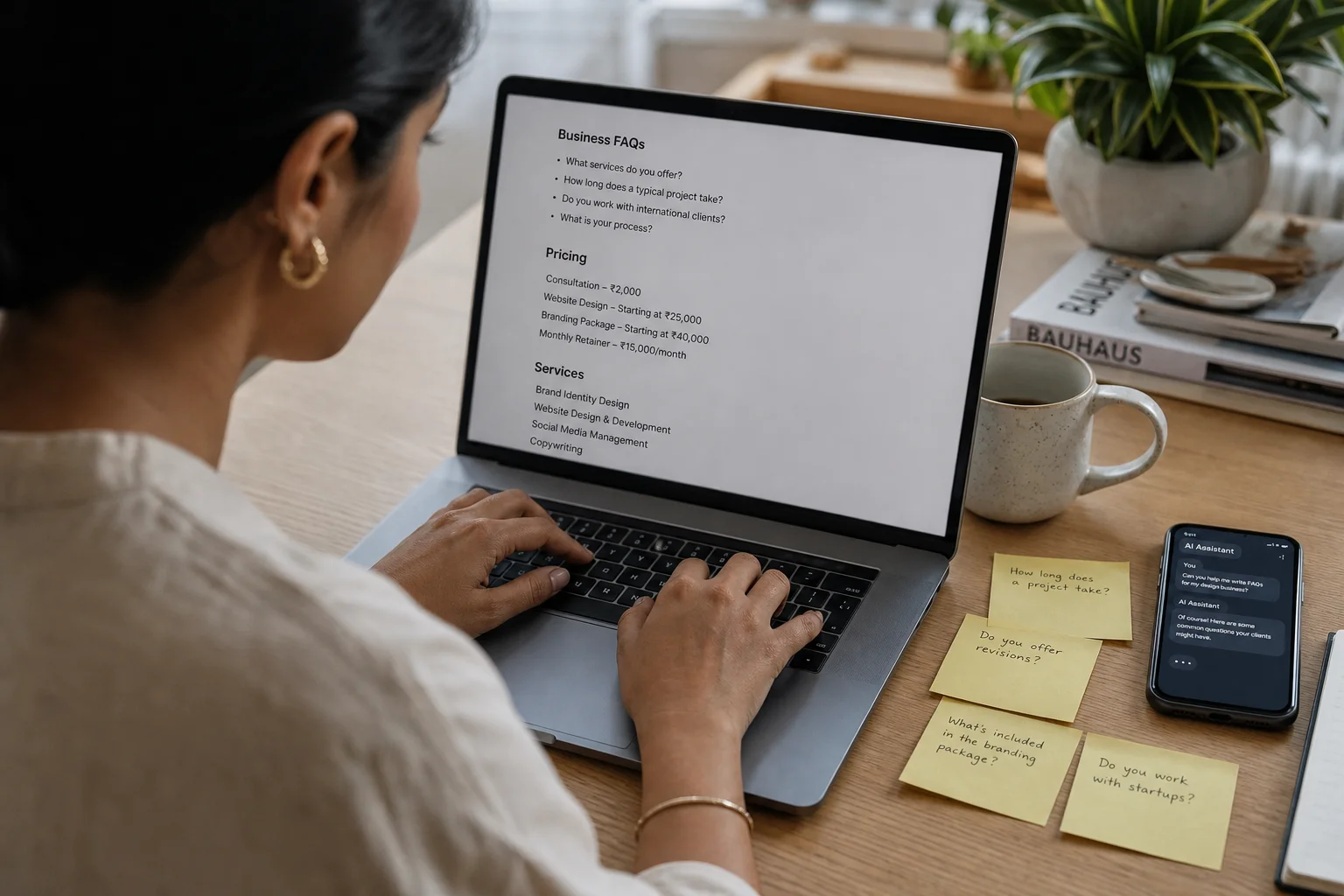
- Write and publish a real pricing guide for your main service — ranges are fine, silence isn't.
- Pull together the 5-10 questions your customers actually ask most often, on the phone or in person, and publish clear, honest answers to each one as their own short section or page.
- Check that your business hours, address, and contact details say the exact same thing everywhere they're listed online.
- Make sure booking or requesting a quote takes one obvious step, not a hunt through your site.
- Ask a few recent happy customers for a review, specifically on the platform where you have the fewest.
- Test it: ask ChatGPT and Google the questions a customer would ask, and see what comes back about your business today, before you start.
None of this requires years of history online to do well. A business starting today, doing these six things properly, is in a genuinely competitive position against an older business that never got around to any of them.
If you'd rather see this done for you than do it all yourself, our next post breaks down exactly what we can build for each of these six items — the specific tools and automation behind each one.
Frequently Asked Questions
If I don't have a website yet, am I already behind?
No — and this is worth being clear about. 'Behind' means everyone else already did the thing you haven't done yet, and you're playing catch-up on the same game. That's not what's happening here. The rules themselves changed. A 10-year-old website stuffed with old-style keyword pages isn't automatically ahead of you — in some cases it's actively behind, because it was built for a version of search that's fading. You're not behind. You're starting at a different, and in some ways more level, starting line.
Does this mean I don't need a website at all?
No — you still need one, and this article isn't arguing otherwise. What's changing is what the website needs to contain and why. A website full of vague marketing copy won't help you much in AI search. A website with clear pricing, real answers to real customer questions, and clean technical structure is exactly what AI systems are looking for. The website isn't disappearing — its job is changing.
What's the single highest-value thing I can do this month?
Publish real pricing information and turn five real customer questions into five clear, honestly-answered pages. Both are things a business with no website history can do just as well as a business that's been online for 15 years — arguably better, since a new page can be written with this in mind from day one.
Is this the same thing as regular SEO?
It builds on regular SEO rather than replacing it — a fast, crawlable, well-organized site still matters. What's new is the emphasis: the goal used to be ranking high in a list of links. Now it's being the specific fact an AI system quotes back to someone asking a question. That requires the same technical foundation, plus content written to be directly answerable, not just findable.
How do I know if this is actually working?
Ask the AI systems yourself. Periodically ask ChatGPT, Google's AI answers, and Perplexity the exact questions your customers would ask — 'best [your service] in Orlando,' pricing questions, comparison questions — and see whether your business gets mentioned, and how accurately. That's a real, checkable signal, not a guess.
Want a clear read on where your business actually stands in AI search today?